It is probably safe to say that not too many people think about death often and that most would consider it odd or even “morbid” to talk about dying. You would probably receive quizzical looks from your companions (at the very least) if you tried to raise the matter as a topic of conversation in a cocktail party.
But if you really did give it some thought, perhaps people should think (and talk) about death more often and more deeply since it can (and should) be considered as an integral part of living. After all, it will come to all of us at some time.
In fact, Buddhists consider death and dying as central to their lives. The awareness of death becomes a key element in shaping one’s life, guiding the choices that one makes as one goes through life.
When one begins to think of death, the inevitable question that must be addressed is, so what happens after one dies?
Atheists would say that nothing happens. Death is the end of everything for the individual. There is no afterlife, there is no heaven where one would spend eternity in communion with God, there is no hell where one would spend eternity in unimaginable suffering. We just have one life and nothing follows.
Agnostics would say, well, we can’t really say what will happen. We don’t really know if there is a God or not and therefore whether there is an afterlife or not. If there is no God nor an afterlife, well, that’s ok. We are not really expecting anything. But if there is a God and an afterlife, that would be a pleasant surprise!
Others who belong to different religious faiths, whether they be Christians, Muslims, Hindus, Jews or adherents of a host of other faiths believe in an all-powerful Spiritual Being and a form of an afterlife. Buddhists believe in an afterlife but no “God” to speak of. Buddhists and Hindus are unique in also believing in reincarnation.
My particular belief is that each person has a spirit or a soul or an essence within oneself. If one reflects on one’s childhood and on different stages of one’s life, one can identify an essence of one’s “self”, regardless of how physically, intellectually or emotionally different one was in each of these stages.
I have some distinct memories of my early childhood, such as when I climbed a tree when I was perhaps 3 or 4 years old and stuck my foot in a crook of the tree and could not remove it. I began to panic and started to cry out loudly until an adult came to dislodge my foot and helped me climb down. After that experience, I no longer wanted to continue my climb! That “me” then is the same “me” that I am now, some 70 plus years later. It is this “me-ness” or self, or spirit or soul or “life-force” (however one wants to call it) that I believe to be my essence and which I believe will continue to exist beyond the demise of my physical body.
But there is a twist to my personal belief. This soul which will survive beyond my death will not retain my personality, my identity, my “me-ness” but will be a formless spirit or consciousness which will realize and become aware of the universal consciousness that we are all part of now, but which we are not aware of now because of our upbringing and the focus on the physical world and the aspirations that develop as we grow.
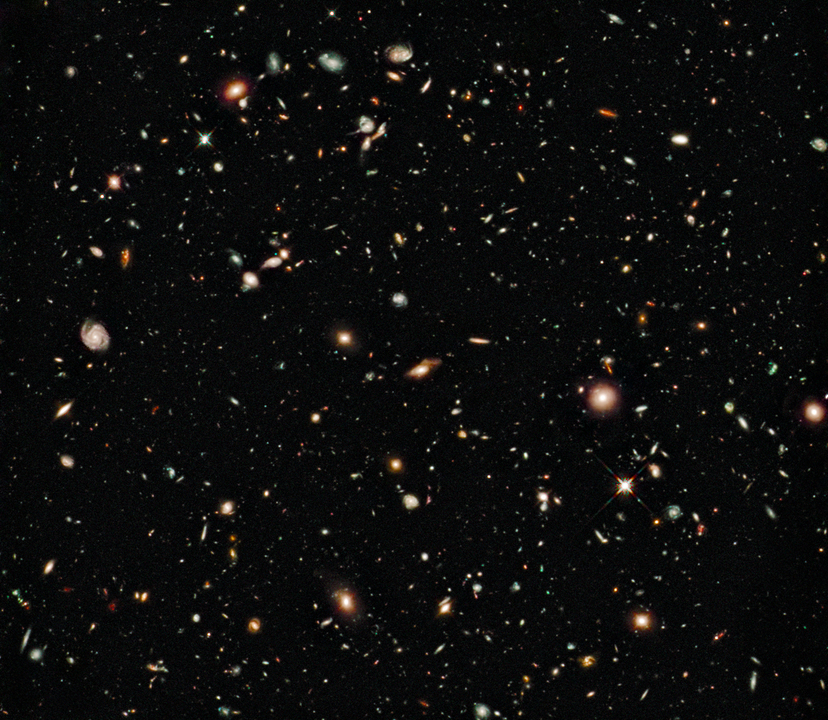
Hubble’s Deepest View of the Universe
Credit: NASA, ESA, G. Illingworth (UCO/Lick Observatory and the University of California, Santa Cruz), R. Bouwens (UCO/Lick Observatory and Leiden University), and the HUDF09 Team
It is only in moments of meditation that we catch a glimpse of the larger consciousness and reality that we are in essence part of. The more we are able to connect with this universal consciousness as we navigate the individual lives we live, the easier will we be able to make the transition from this life to what lies beyond it.
If you think about it, this personal perspective of mine is really not that different from that of many of the religious or spiritual traditions. I do believe in a universal being or power. I also believe in a “soul”, if you want to call it that, as well as an afterlife, an existence beyond this life. Some of the main differences though from, say, Christian beliefs, is that my “God” is not an anthropomorphic being but rather, as I described it earlier, more of a universal consciousness (words are never sufficient to describe the indescribable). Moreover, I do not believe that my “soul” will retain a distinct personality in the afterlife but rather will come into an awareness of its oneness with the universal consciousness, a oneness that exists even as we go through our mortal lives but which, for many reasons, we fail to be aware of.
But that is only my personal belief.
One reply on “DEATH AND THE AFTERLIFE”
I had a near-death experience in July 2022 while battling Covid and prepping for a quintuple heart bypass surgery. It was peaceful up there in the heavens, with a soft glow of light all over… and a deep reassurance of a deep, abiding, and comforting love beyond description. So, I believe in the afterlife as well and a HIGHER POWER which animates all “creation.”