I moved to Canada in 2011, along with my wife and youngest daughter. We had been sponsored by our eldest daughter who migrated to Canada some 8 years earlier. In the slightly more than a decade that we have been here we have lived in the Greater Toronto Area.
During this time, we have encountered a wide variety of races of people in our neighborhood, on the trains and subways, buses and streetcars, in the malls and pharmacies and restaurants or just strolling along the sidewalks. I have eaten in all types of restaurants and brought home a wide assortment of foods – North American, of course, Chinese, Japanese, Italian, Spanish, French, Filipino, Ethiopian, Indian, Tibetan, Persian, Israeli, etc. – emerging unscathed (but stuffed!) despite political tensions among and between a number of the countries of origin of their proprietors.
In my more contemplative moments, I have often wondered; isn’t Canada inviting trouble with the seeming in-rush of immigrants, each with his or her own set of values and attitudes and cultural practices?
The 2021 Population Census of Canada reports that Canadians include people from 450 ethnic and cultural origins, coming from 200 different places of birth and speaking 450 different languages. Another interesting statistic, this time from the World Population Review, likewise using 2022 data, indicated that there are 206 births per day in Canada and 163 deaths, thus providing a net daily growth of 43 persons per day. But this is bolstered by a threefold inflow in migrations, with 136 migrants entering the country each day, thus providing an actual population growth of 179 persons per day! Canada truly is dependent on immigrants to grow the population of a country which has the second largest land mass in the world!
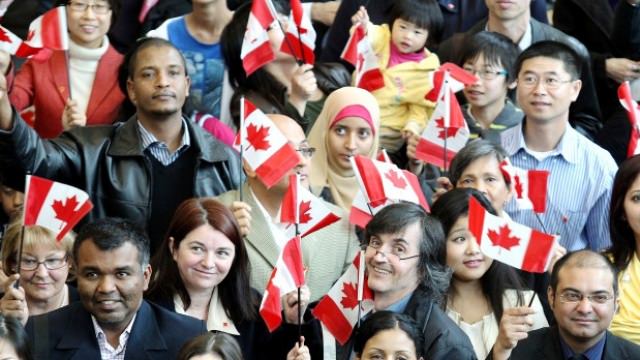
(Photo from Julian Paparella – Canada: A Beacon of Multiculturalism and welcome for the world)
Moreover, multiculturalism has been adopted as an official policy of the Canadian Government, with the Canadian Multiculturalism Act having been passed into law in 1985. Through this policy, immigration has been actively encouraged, enticing people from around the world to move to and settle down in Canada. One suspects that economic growth is the primary objective of this policy, given the relatively small population of the country – approximately 38 million as of 2022 – and the large land area. In contrast, the Philippines, for example, which has a land area which is only 3% of that of Canada, has a population of 110 million, roughly 3 times as large as that of Canada.
But back to the original question: wouldn’t bringing such a diverse population into Canada lead to social problems? How does one deal with the differing values and outlooks of so many immigrants?
As it is, there are signs that social integration is still a work in progress. Bias towards and outright oppression of indigenous peoples is an issue that is constantly in the news. Hate crimes perpetuated against Jews, Muslims, Blacks and Asian immigrants are common. As one prominent Canadian NGO put it, “Hate is Canada’s national crisis”. Canada’s Public Safety Minister recently declared that “racism and white supremacy…are alive and well in Canada”. The Canadian Armed Forces recently advised that they are taking steps to bring systemic and institutional change to address racial bias within the CAF. A Professor from the Ontario Tech University recently noted that since 2015 at least 300 extremist groups have emerged. And so on and so forth.
What is one to make of all this troubling news? Is the image that Canada is a racially tolerant society more of an illusion rather than a reality?
Time will tell.